
The proof is on the roof.
Field trials on working buildings, independent U.S. lab testing and manufacturer durability data — with the sources shown, so you can judge it for yourself.
Thermal camera. Same roof, same moment.
A side-by-side trial on a metal-roofed logistics warehouse in Hangzhou, China. Part of the roof was covered with ACC; the rest was left as bare metal. The membrane is the only difference.
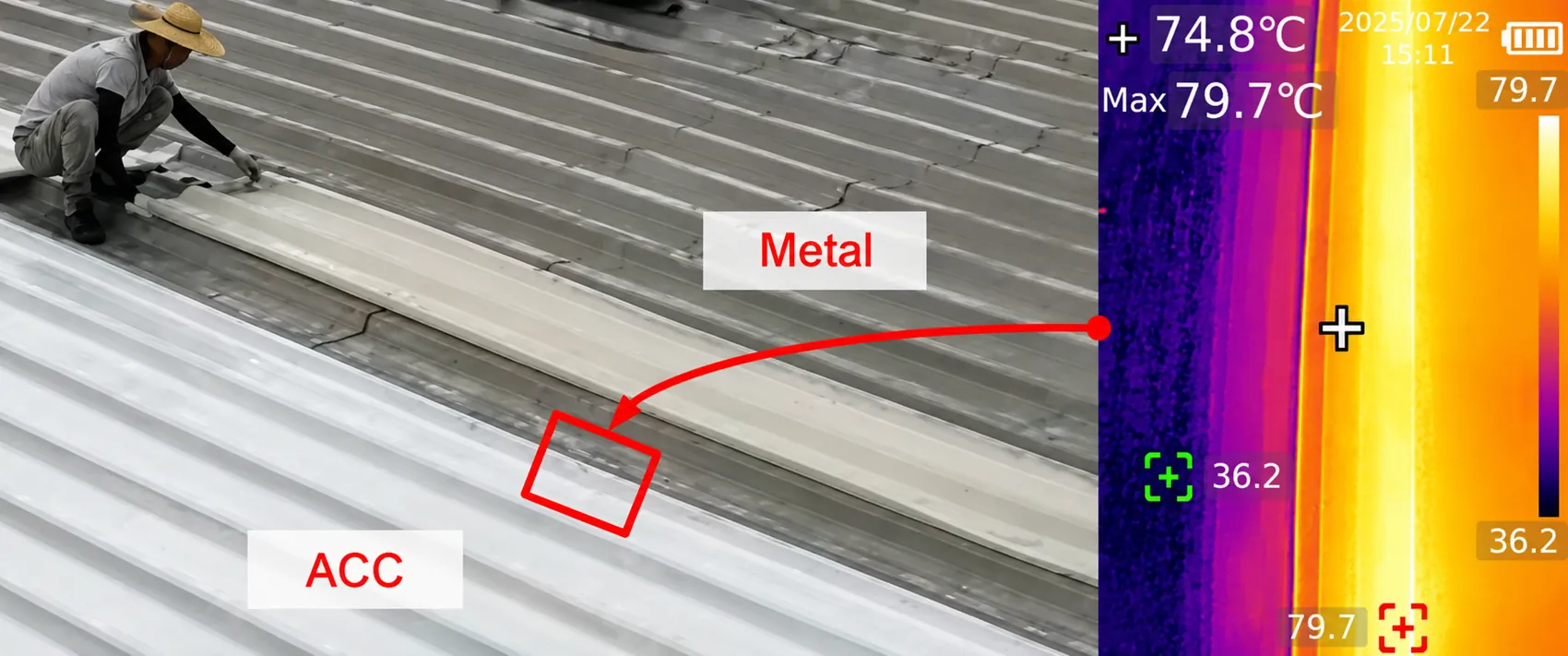
Measured August 2023: 74.8 °C (167 °F) bare metal vs. 36.2 °C (97 °F) with ACC.1
Cooler where it counts.
A cooler roof surface means less heat conducted into the building. On a metal-roofed grain warehouse in Inner Mongolia, China, indoor air below the ACC-covered roof ran up to 12.8 °F (7.1 °C) cooler.2
For warehouses, schools, ag buildings and plants without full HVAC, that difference is felt by people and products. For conditioned buildings, it means less heat for the cooling system to remove.
Maximum indoor air difference
Maximum indoor air temperature difference recorded in the trial: 7.1 °C.2
Solar reflectance
Solar reflectance measures how much of the sun’s energy a surface bounces away (0 to 1). Higher is cooler. ACC’s aluminum foil layer is the cool-roof performance layer.
| Source | Method | Solar reflectance | SRI |
|---|---|---|---|
| Independent U.S. laboratory (ACE Laboratories, July 2026) | ASTM C1549 / C1371 | 0.83–0.84 initial | 92–95 initial |
| Manufacturer published value | ASTM C1549 | 0.87 | — |
| Manufacturer specification (minimum) | ASTM C1549 | ≥ 0.80 | — |
| Test / property | Standard | Result |
|---|---|---|
| Accelerated UV weathering, 5,000 h | ASTM G154 (QUV) | No corrosion, chalking or delamination |
| Salt spray resistance, 1,440 h | GB/T 17748-2016 | Level 1 |
| Acid rain resistance, pH 3.15 | ASTM D7356 | No corrosion |
| Acid / alkali stability | pH 2 to 13 | Stable |
| Humidity / condensation, 720 h at 47 °C / 96% RH | GB/T 1740-2007 | Level 1, no corrosion |
| Ageing, 28 days at 70 °C / 90% RH | ISO 22097 | No corrosion |
| Low-temperature flexibility, −4 °F (−20 °C) | GB/T 328.14 | No cracks |
| Heat resistance, 176 °F (80 °C) | GB 23441-2009 | Stable; slide ≤ 2 mm at 70 °C |
| Water contact angle | — | > 90° — easy-clean, self-shedding surface |
Several durability tests were conducted to Chinese national (GB) standards by the manufacturer. U.S. third-party testing and listings are in progress.
Want to see it on your roof?
We can help plan a trial section on your building so you can measure the difference yourself.
- Side-by-side metal roof trial, logistics warehouse, Hangzhou, China, August 2023: roof surface 74.8 °C (167 °F) on bare metal vs. 36.2 °C (97 °F) with ACC, measured by thermal camera at the same moment. Results vary with climate, substrate and building.
- Grain warehouse with metal roof, Inner Mongolia, China, July 2025: maximum indoor air temperature difference 7.1 °C (12.8 °F). Results vary with climate, insulation, ventilation and building use.
- Independent U.S. laboratory testing (ACE Laboratories, Ravenna, Ohio, July 2026) to ASTM C1549 and ASTM C1371 on two production batches: initial solar reflectance 0.83–0.84, SRI 92–95. These are initial lab values, not a Cool Roof Rating Council (CRRC) rating. CRRC rating is in progress.
- Manufacturer data — San Miguel Yamamura Woven Products, ACC WF501C-BU specification sheet and product manual. Test methods as stated. U.S. third-party listings are in progress.